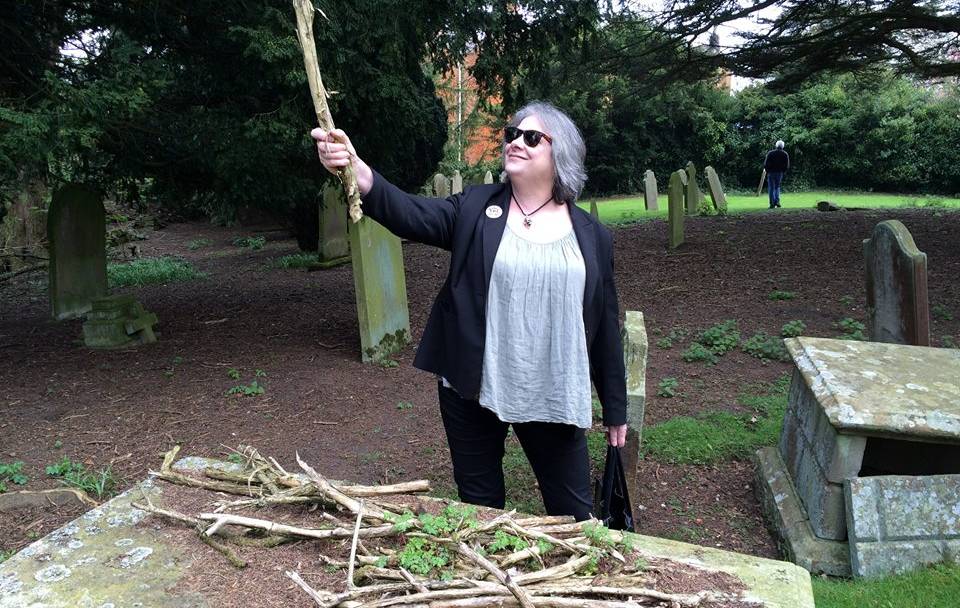
Gail-Nina Anderson

Gail-Nina Anderson at The Magpie, Whitby

Lectures at the University Gallery

Gail-Nina Anderson will give a series of guest lectures at the University Gallery of Northumbria University, Newcastle-upon-Tyne. Admission is free, but a donation of £3 per person per lecture is invited; places can be booked by telephone on 0191 227 4424.


Wednesday 16th January, 6.00 pm: A Spooky Start to the Year
The beginning of any enterprise is traditionally an anxious, ambiguous time - so why not start 2008 with an evening's entertainment that keeps the spectres at bay by raising a few ghosts of its own? In the tradition of our midwinter and midsummer ghost stories, this is a January session of spooky, atmospheric tales old and new, read by Gail-Nina Anderson at her most Gothic. As winter and weirdness combine to chill your spine, join us to restore your spirits with a glass of wine and to fortify your nerves by listening to some stories of spectral strangeness that don't have to be taken too seriously.
Saturday 26th January, 12.30 pm: Work - Ford Madox Brown's Urban Panorama
If you thought that the Pre-Raphaelite Movement was all about drooping mediaeval ladies, think again. Ford Madox Brown's epic painting Work was intended as a statement on the rôle of labour in mid-Victorian society, and still stands alone in its searching description of the contemporary London world as one remarkable man saw it. This talk will look in detail at what is going on in the painting (now owned by Manchester City Art Gallery), as well as considering how and why Brown undertook such an unusual project. From the picture's realistic setting and Pre-Raphaelite style to its contemporary references and idiosyncratic social commentary, this is a chance to explore a dazzling image that draws on symbolism and naturalism, heroism and humour, phrenology and photography to put the working man into the frame.
Wednesday 13th February, 6.00 pm: The Image of the Miner
To accompany the highly distinctive work of Norman Cornish, this talk will look at the imagery of miners, pits and mining communities in the paintings of such artists as Tom McGuinness, the Ashington Group and van Gogh. It will also consider the less formal representations which have contributed to this history, with French Realist novels and Victorian social reform helping to mould our views alongside contemporary newspaper illustrations and photographs. These images will be put into context alongside other representations of the working classes, and will include that troublesome issue which worried the Victorian establishment - what should a female miner wear?
Saturday 15th March, 12.30 pm: The Art of Fearful Imaginings
The rôle of art goes far beyond simply delighting or informing the viewer, and this talk explores a particular strand of imagery designed to rouse a darker emotional response. From Mediaeval devils to Romantic nightmares, spectral visions to exteriorised neuroses, art has given shape and expression to the things that lurk in those hidden corners we might prefer not to explore. Painters such as Goya and Fuseli call up images intended to provoke a shudder - is this simply sensationalism or do we need to visit the dark side? Does the visualisation of our imagined horrors give them power or put them in their place, and why do we so often find ourselves laughing at what is meant to be scary?
Wednesday 9th April, 6.00 pm: The Sculpted Portrait
Have you ever seen a Ancient Roman bust with a face you might meet in the street, or encountered an eighteenth-century statue that reminds you of someone in your family album? While it might seem logical that the colour and apparent spontaneity of painting or photography would make these the perfect media for depicting the likeness of an individual, the sculpted portrait can boast an equally long history within which changing traditions of style and function can be observed and explored. Vastly underrated, the carved or moulded likeness has formal qualities of its own which deserve a fuller appreciation and reward a closer examination than they are usually given. This brief history invites you to be surprised by the variety, individuality and visual possibilities the genre offers, when apparently intractable materials are transformed via the language of form into the stances and features of real people.
Wednesday 23rd April, 6.00 pm: Hogarth and the City
One of the greatest and most innovative of all 18th century painters, William Hogarth virtually invented an enduring visual vocabulary of city scenes and characters. It is no coincidence that just as the contemporary English novel was establishing new ways to depict its characters both as recognisable individuals and within their defining social context, Hogarth was creating similar stories in visual form for an urban audience that now expected art to show it its own (not always flattering) reflection. Hogarth's views of London life provide us with an enduringly fascinating social history in the liveliest of styles, packed with memorable characters, giddy fashions, busy streets and interiors that vary from the height of elegance to the depths of squalor. Somewhere between the high public morals and the bad behaviour, this represents visual story-telling at its most sophisticated and urban imagery at its most finely observed.
Wednesday 21st May, 6.00 pm: The Cut of his Coat - Costume in Portraiture
What would you wear if you were having your portrait painted? Would it be something of classic elegance or this season's new fashion - or would you opt for timeless draperies to transcend the moment? The role played by the sitter's costume is more vital than we might expect in the way a portrait presents and characterises its subject. This talk will track the fashions in fashion - when was it appropriate to show off your wealth in satins and jewels and when did sober simplicity say more about your status? Which costumes were actually worn and which are fantasies of fancy dress or even historical quotations? How can the colour of a garment affect our perception of the wearer and who makes the choice? With examples from the Renaissance to the 20th century, explore the social and artistic significance of who is shown wearing what in European portraiture.
Wednesday 25th June, 6.00 pm: Sickert
Perhaps it was the German, French and Danish elements in his background that made Walter Sickert (1860-1942) into so idiosyncratic an artist of the late Victorian / early 20th century scene. His art can be associated with that of Whistler, Degas and the Impressionists, with the harder edge of the Camden Town Group and with contemporary dialogues between painting and photography. His style takes the Impressionist brushstroke and reloads it with darker tones - and the same could be said for much of his imagery. From luminous views of Venice and Dieppe to the tawdry glitz of the music hall and the dull interiors of urban boredom and anxiety, even now Sickert remains a recognisably modern artist in the way he visualises his world. This is the artist who has been associated with the Jack the Ripper murders - an implausible theory which is an accolade of sorts to the insight and immediacy of his art. Behind Sickert's canvasses stands someone armed not with a knife but with the eye of the unsentimental (but not unsympathetic) compulsive observer.
Saturday 5th July: Durer's Rhinoceros
It may be anatomically incorrect and more than slightly fanciful in its details, but when in 1515 German Renaissance master Albrecht Durer produced a woodcut print of a rhinoceros, he created one of the most enduring, popular and widely imitated animal images in the entire history of art. This talk explores the history of such an unlikely icon, discussing the animal that inspired it, the reasons for its production and the artist's telling choice of medium and technique. No real rhino ever packs quite the same punch as Durer's beast, so it stands not just as a telling (if not entirely accurate) document in the art of natural history, but also as a testament to the power of the popular print to show us marvels and convince us of how they should look.


Cornwell Internet

Last update: 3rd April 2008.